If you’d told me I’d be making kombucha even as recently as just a few short years ago, I’d have said ‘no way!’ For me kombucha was the weird slimy thing my Dad was growing in his kitchen in the early 80’s.
Dad has always been adventurous in the kitchen and he’s also always fancied himself a bit of a health food enthusiast. He was doing the Master Cleanse before I’d ever heard of it. That’s the one where you drink nothing but lemon water, maple syrup and cayenne pepper. As a kid – and even as a young adult, I didn’t know anyone who’s parents ‘cleansed’. We grew up in Alberta, not California!
He was also brewing up kombucha. My bro’, who lived with him at the time, thought it was gross.
Anyway, with my recent interest in fermented foods I’ve been thinking about giving kombucha a try on my own. I haven’t told my Dad, or my brother, who I’m sure would grimace at the thought.
Like so many fermented foods like sourdough, kefir or yoghurt, to make kombucha you need a starter culture. In kombucha’s case the culture is called a SCOBY, an acronym for ‘Symbiotic Culture of Bacteria and Yeast’. Apparently a scoby is similar to the culture that is used to make vinegar, and in fact the finished brew can become quite vinegary if given the opportunity.
There are a few ways to purchase these. Online I found live cultures as well as dehydrated cultures. It seemed to me that rehydration seemed a little less certain than a live culture, but it’s winter here and I was worried about shipping a live culture through the frozen North.
At some point during my scoby hunt it occurred to me to check Kijiji and bingo(!) I found a woman who was selling her extra scobys at $10, half the cost of ordering online. Well, by the time I factor in my gas and travel time to go pick up my strange slimy new baby it probably was a close one as far as cost goes. Anyway, at least I knew it was alive and well.
After convincing Steve to drive me 4o minutes across town to pick her up, I carefully brought her home to begin the process of starting my first brew. Well, after a pit stop at the Crossroads farmer’s market on the way home to pick up some buffalo hungarian sausage. I had to carry my precious jar of scoby and starter tea through the market under my jacket. I was worried that she would get cold or freeze if left in the cold car.
Once home, I got to work.
Making kombucha is actually really easy. Brew strong black or green tea, cool, add sugar, scoby and starter liquid or vinegar to ensure that the mix is a bit acidic, cover and wait. The scoby uses the sugar as fuel to grow and ferments the liquid into a yummy probiotic drink.

A short second fermentation can be done with the addition of fruit juice or fruits to make the kombucha fizzy and pop like. For my first try, I divided my brew into three. I left one small bottle plain, and mixed two bottles with 1/2 Cup of organic mango and orange juice, and two mason jars with 2/3 Cup sliced fresh ginger and pineapple. The flavoured varieties will be left for a few days on the counter to go into a second fermentation and then will be strained and moved to the fridge.
Plain kombucha is difficult to describe. It has a mildly fermented flavour, like watery beer, but it is distinctly tea like at the same time. I like it. I’m looking forward to trying my flavoured varieties in a few days too.
To purchase a live culture, and for tons of information on everything Kombucha, I highly recommend checking out Kombucha Kamp
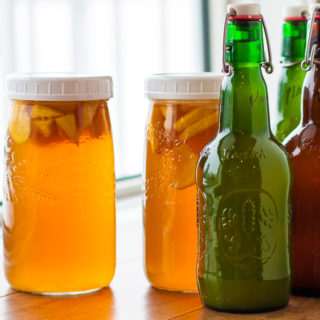
Black Tea Kombucha
Ingredients
For a 1 Gallon container
- 1 Kombucha scoby fresh or dehydrated. Ideally get a SCOBY from someone who already brews and can offer you some starter tea along with it.
- 2 C starter brew
- 2 C boiling water
- 5 bags good quality plain black tea like english breakfast. Organic is best but not necessary
- 1 C white sugar. Again organic cane sugar is perhaps best but plain white sugar will work
- Cold filtered or distilled water to fill container
Instructions
Note: If using a dehydrated SCOBY, rehydrate using suppliers directions
-
Boil 2 Cups of water
-
Stir in 1 Cup sugar to disolve
-
Add tea bags and steep until tea is strong
-
Remove tea bags from sugary water and allow to cool
-
Add sugared tea to your 1 Gallon container
-
Add 4 cups filtered or distilled water to be sure mixture is warm but not hot. You want your tea mixture to be room temperature
-
Add your starter tea and live or rehydrated SCOBY to the tea and top with water, leaving headspace in the container
Recipe Notes
Try to get a 1 Gallon container that is fairly wide. Your SCOBY will grow to fill the top of the container, and a wider SCOBY ferments more quickly.
 I'd love to connect via social media! Find me on the channels below, or if you'd like to know more about me and this blog